Work Less PROFIT More Business Podcast
Tune in each week as Diana Lidstone shares business strategies, tips, and resources so you can work less and profit more. This business podcast is for established business owners who want to stop being the Chief Everything Officers ... but still want to make more money!
The truth is....business owners who earn 10x more DO NOT work 10x harder. Diana coaches her clients to go from low 6-figures to 7-figures and beyond using her results-driven framework.
Whether you're a financial advisor, lawyer, real estate investor, or another expert, here's the truth: you've successfully grown your business but now find you're caught in the hustle and chasing the money. I totally understand. It's time to finally have the freedom you've always desired.
You can read more also at www.dianalidstone.com/blog
Work Less PROFIT More Business Podcast
Ep. 05 - The Most Common Marketing Objection I Hear…
Use Left/Right to seek, Home/End to jump to start or end. Hold shift to jump forward or backward.
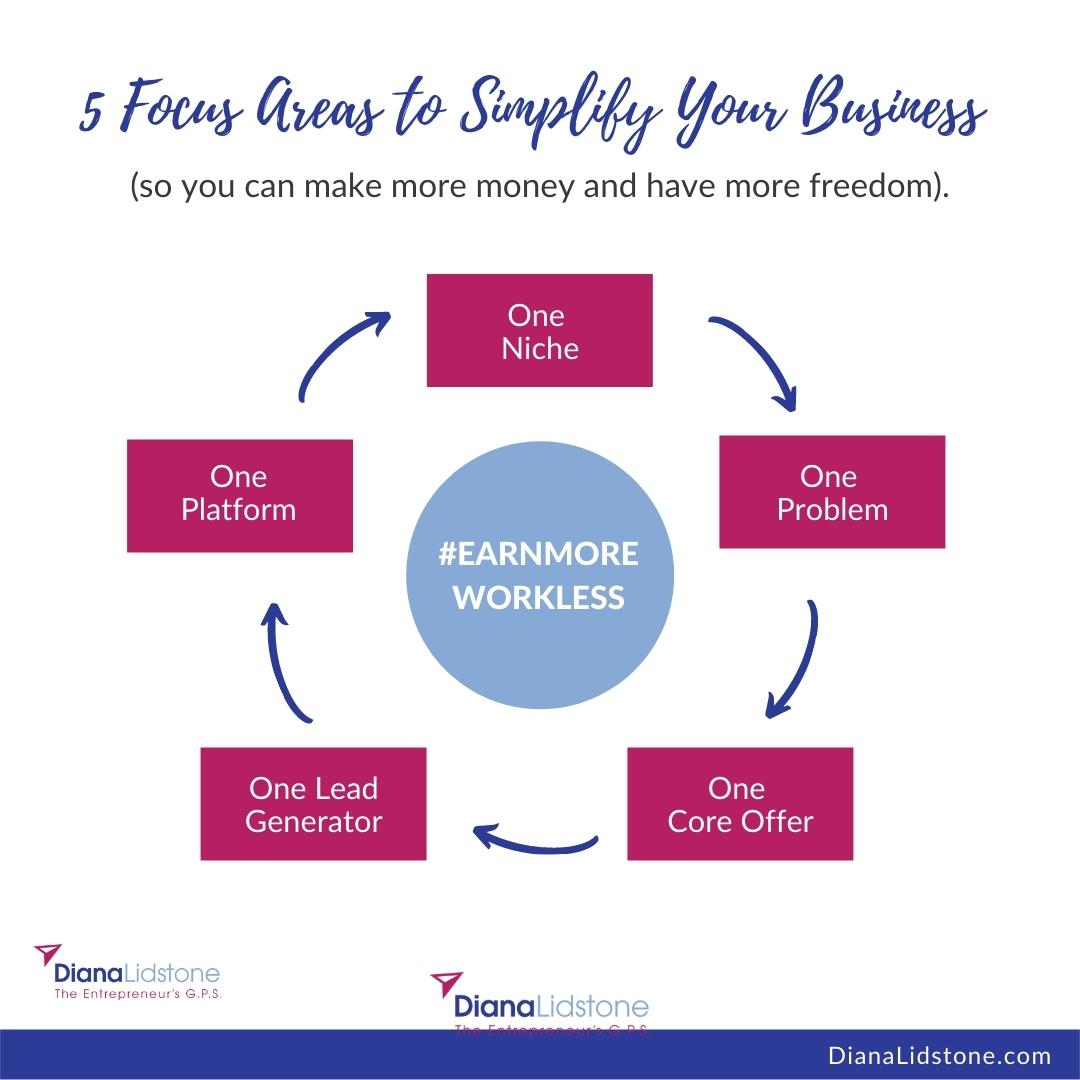
Part 2 of the Simplify Your Business series -- the best and most powerful way to transform your business, your brand and your marketing so you can work less, earn more.
REFERENCES
- Ep. 04 – 5 Powerful ways to simplify your business (listen)
- 5 Powerful Ways (download)
READY FOR MORE?
Have questions? Book a call at Growth Strategy Session to see how we can best support you to simplify and scale your business, and your next best step to #worklessearnmore.
Love this podcast? Then you want to join the Think Like a CEO Facebook Community for weekly mini-trainings and Q&A with Diana.
Share your feedback with me by clicking here and leaving a short voice message!
Carl Richards: Welcome to The Grow Equation Podcast, a training podcast for service-based business owners who want to hashtag work less, earn more. Your host, Diana Lidstone has been working with businesses for more than three decades to help them get known as the undeniable authority in their industry, wrap up their profits and optimize their resources with the end goal that they work less and earn more. So if you're ready to implement simple steps to banish the hustle and to do business differently, then stop, stop folding laundry or running on your treadmill. Grab a pen and paper, and let's dive into today's episode.
Diana Lidstone: Hello and welcome to another episode of The Grow Equation Business Podcast for business owners who wanna work less and earn more. This is the second in the series of how to simplify your business, make your marketing easier and attract high paying clients. Now, if you miss the earlier episode where I quickly outlined the five powerful ways to simplify your business, you might wanna go back and listen to that first. Let's dive in one of the easiest ways to simplify your business and especially your marketing is to what I call micro-niche. In other words, niche down and yet it is the one marketing strategy that clients give me the most pushback on in the over 35 years that I have been in business and been coaching. I wish I had a fricking nickel for every time I heard an objection to this particular strategy and what I hear is, but if I niche down, if I narrow my niche I'm going to eliminate some people I can help.
Well, while that might be true, I'll guarantee that when you niche down, you are going to simplify your business. Your marketing will become easier and those high paying clients, they will love coming to you. So the purpose of narrowing your niche is to create that more effective marketing that attracts the dream clients that you want. It doesn't mean that you won't work with someone who is outside of your niche. So would you like to make your marketing easier? Would you like more high paying clients? Would you like to simplify your business? Then let's explore exactly what a niche is, the benefits of nicheing down and several steps that you can take today to simplify your business. So what the heck is a niche? A niche is simply a small group or subsets of a bigger group of potential buyers that your marketing speaks directly to them.
If you're listening to this pay attention to this, it is that subset of buyers that your marketing speaks directly to. So women could be a subset group of people professional women could be a subset group, professional divorced women could be another subset, professional real estate women another subset, you see so narrowing down your niche makes your marketing easier. And here's what I mean if we use the example of a financial advisor, the marketing language that a financial advisor might use to attract professional women would be very different marketing language. If they wanted to attract professional divorced women, why? Because their problems are different professional divorced women are going to have very different problems, they're going to have very unique problems. Maybe their biggest concern is because they are the single breadwinner of the family how do they protect those financial assets? So the marketing language would address the particular and the primary concern.
So setting yourself up as an expert for a micro-niche will simplify your life, your business, and your marketing. So here are some very easy benefits that I recognize, the first one is creating content for you becomes more focused and easier so let's go back to the financial advisor, if the financial advisor is creating content of value and he just uses a very broad general range. It seems that it's a little more difficult to create content, but when the content is for divorced women, you can really niche down and you really genuinely provide value for those women. So that is one of the major benefits when you niche down, creating content it becomes more focused. It becomes easier, and it's much more value. That's what you want, because you want your prospects to see that you are a valuable resource.
All right, when you niche down, it is also easier to recognize your ideal or your dream client. So again, if we talk about professional divorced women, we know yes or no whether somebody is divorced or not, or about to be divorced It's easier to recognize them out there in the marketplace. A third benefit might be that strategic associations and referrals become easier and stronger. And I know this to be true I've seen it happen for many of my clients. That for instance, if they narrow down their niche to a group of people that had their own association, then they could be seen by those association members as a very strong resource partner. Another benefit is that you get asked to speak on your expert topic because you are now perceived as an authority and everyone on your team, whether your team is just a VA, a bookkeeper, or if you have employees; your team should be part of your quote and quote "sales team".
And they will be able to easily recognize your dream clients out there. When you niche down one of the things that I love about nicheing down, first of all, is that clients come to you expecting to pay higher fees. That is the truth, if you were going to look for a doctor now, let's say it's a heart surgeon. First of all if you went to a GP, that's not quite a heart surgeon, but you went to a heart surgeon, you would expect to pay more for their services than you would a GP. But what if you really needed a pediatric heart surgeon that's even nicheing down even more and you would go to that doctor expecting to pay higher fees because they are so specialized. Well my client, Cynthia is an amazing example, a superb example of how a business can totally transform by micro nicheing.
Cynthia is a lawyer. And before nicheing down before micro nicheing, her business struggled financially, and she competed on price like a commodity, not a great place to be. But while working with me, she began to focus on serving serious real estate investors and their families. By focusing her efforts on this industry, she joined their association was frequently asked to speak, created several strategic alliances or referral partners, which has impacted her business in ways that she never thought possible, her business has scaled and the profit has increased dramatically, so she simplified her business, her profit sword, her marketing became so much easier. Now I hope to have Cynthia on a podcast episode in the near future. So keep listening for that. So how could you niche down your business? How could you focus on a much smaller niche so that everything became more efficient and easier?
Well, I wanna walk you through a couple of simple ways that might help you specifically. So let's look at number one, and this was the case for Cynthia. We identified a particular area of interest and passion come to find out. After working with Cynthia for a few months, she had this passion for real estate investors and she was also a real investor herself. She understood the market and it was something that just lit her up. You could just see every time she started talking about real estate and investing how much joy that brought to her. So if you can identify a particular interest or passion, not only will it bring that joy back into your business, but it's gonna help you so much. A second way would be to actually research your market, research and people say well, how do I research? Google is your best friend when it comes to research.
So Google out there, where is your market? Where are they underserved? What in the marketplace who is not doing what you are willing to do? And because maybe you're willing to do something that your competition isn't willing to do. Is there an opportunity for you to stand out and become known as that go-to expert in your field? For instance, I could use myself as an example. And over the years, my business has morphed and it has transformed over the last two years I keep simplifying it and simplifying it. And business coaches and marketing coaches, there are tons of them out there, but I focused in on women business owners who a have lost their passion. And why have they lost their passion for their business? Well, there's many reasons, but the two biggest reasons is cuz they're working their fingers to the bone.
They're working 24 7. They're just not getting paid enough. They feel like they've got a fricking job and that's not why they started their business. So when I combine their pains about losing this joy, losing this passion and that they wanted to work less and earn more, that has been the best decision I ever made for my business. So research your market. Number three this is really, really critical and I've seen this happen to people when they niche their market or micro niche, their market, especially in areas of not for profit or non-profit, you've got to make sure that there's a good margin of profit for what you're doing. That there's a large enough market to serve. The other consideration is you have good access to this market. So if we look back at Cynthia as a lawyer and she had easy access to a real estate investing association, they started to ask her to speak so that profitability, she was able to check that one off and the easy access.
She was able to check that off. If you're a good heart and soul who wants to serve underprivileged or people who don't have the money, et cetera be careful how you position yourself in the marketplace. I always say that the best way to do that, the best way to serve those people who perhaps can't afford you or who are at the lower end of the income spectrum, is to create a super profitable business and then give back, give back whether it's a charity give back whether it's a scholarship, whatever, but make sure that there is a good profit margin. Number four is to make sure that you can put a name to this niche. And here's what I mean, you want people in your micro niche to be able to self-identify when you are talking to them. So for instance, you could use a series of words and subconsciously will your niche, your target market, your ideal client, will they be able to say, yes, I am that or no, I am not.
And here's some examples, you know whether you are a mother yes or no, a real estate agent yes or no, a coach, a speaker, an author. Those are all they, that people can go, yes, I am one of those or no, I am not. So as you are, nicheing down, try to put labels on these people so that they can easily self-identify. So for instance, I'll use an example of my friend, Katherine Burrows who is a ghost writer. And again, her business has gone through some transformation and originally she was doing all kinds of different writing, but she decided recently that she wants to ghost write people who have this book yearning to write a book or multiple books. And so she is a ghost writer for coaches and speakers and consultants who really want to grow their impact through writing a book.
And so when she says coach or speaker, people go yeah, I'm one of those and then they also self-identify with the problem that she's talking about. The fifth way to narrow your niche, go down into a micro niche is to just keep testing and tweaking and adjusting. Nothing in business is forever and nothing in business is a straight line. Marketing and business is all about continually testing it out there in the marketplace, tweaking it and adjusting it. So be sure to do that so those are five simple ways that might help you narrow your niche. I hope that has been useful to you, but I want to just sum this up by saying narrowing your niche is one of the best ways to get known as the undeniable authority in your field It will shift your business. Now next week, we'll wanna continue with this theme of simplifying your business. As we examine the second element of simplifying, which is identifying and focusing your business and your marketing on solving one problem for your new micro niche until next week I know you can do this.
Carl Richards: Thanks for listening to The Grow Equation Business Training Podcast, where it's all about hashtag work less, earn more. Before you go, please take a moment to leave us a review, if you enjoyed this and want more of Diana, you're invited to join her private Facebook community for live trainings, articles and Q and A head over to facebook.com/groups/think like a CEO with Diana until next time thanks for listening.